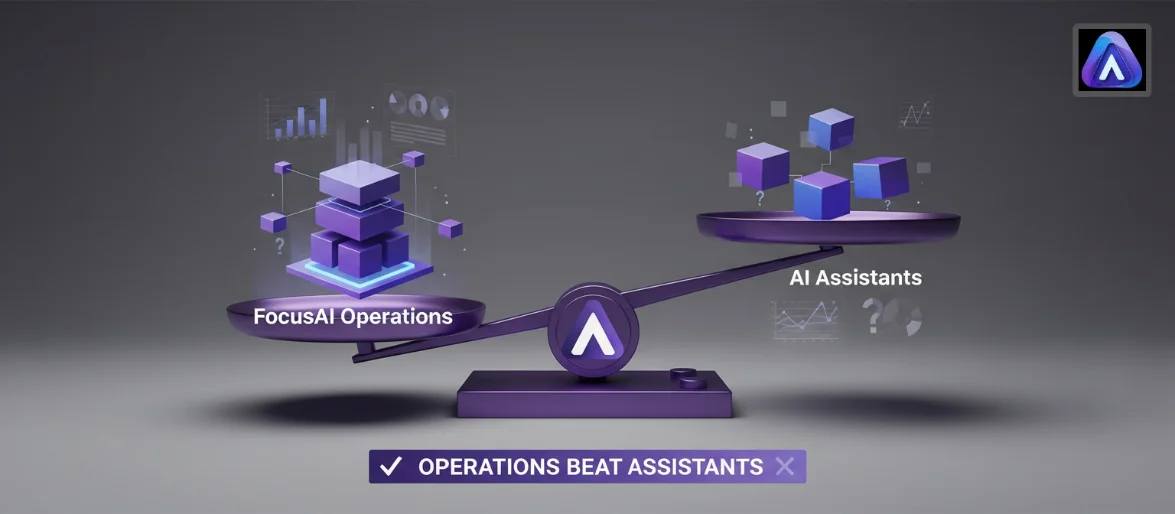
The Evolution from Generative Assistants to Integrated Operations
The first wave of AI adoption was defined by 'writing assistants.' Tools like Jasper, Copy.ai, and Writesonic—the 'Big Three'—revolutionised how we draft text. However, for UK-based SMBs and scaling SaaS companies, drafting text is only 20% of the challenge. The real bottlenecks lie in factual verification, brand consistency, and the friction of disconnected tools. FocusAI represents a paradigm shift, moving beyond simple generation into full-scale AI content operations.
Full-scale AI content operations
Technical SEO and professional publishing
While generic assistants rely on the creative but sometimes unreliable output of Large Language Models (LLMs), FocusAI is built for technical SEO and professional publishing standards. In this comparison, we explore why a unified Content Suite is replacing the fragmented workflow of prompt-based tools.
Quick Overview: FocusAI vs. The 'Big Three'
| Feature | Generic AI Assistants | FocusAI Content Operations |
|---|---|---|
| Primary Goal | Fast copy generation | End-to-end content lifecycles |
| Factual Accuracy | LLM-dependent (High risk) | Google Grounding (Fact-grounded) |
| Technical Output | Rich Text / HTML | MDX Publishing / Structured Data |
| SEO Depth | Basic Keyword density | AEO Analysis & Semantic Mapping |
| Onboarding | Simple prompt memory | Deep Brand Onboarding |
The Critical Flaw of Disconnected Tools
Content agencies and SaaS teams often find themselves trapped in a cycle of disconnected tools. They use one tool for research, another for drafting, a third for SEO analysis, and then manually migrate content into a CMS. This fragmentation creates operational debt. FocusAI eliminates this by housing the entire workflow—from initial brand onboarding to final MDX publishing—within a single, cohesive environment.
Why Google Grounding and Fact-Grounded Content Matter
The greatest risk for professional brands using the 'Big Three' is the reliability of information. Generic tools pull from their training data, which can lead to outdated or incorrect claims. FocusAI utilises Google Grounding. This ensures every piece of content is fact-grounded in real-time search data, making it suitable for YMYL (Your Money Your Life) industries and technical SaaS documentation where accuracy is non-negotiable.
Comparing the Content Lifecycle
FocusAI vs. Generic AI Assistants
A side-by-side analysis of features critical for modern content operations and technical SEO.
| Feature | Generic AssistantsBest for short-form social copy and basic creative drafting. | RecommendedFocusAI SuiteSpecialised for high-volume, high-accuracy technical content production. |
|---|---|---|
| Google Grounding | No | Yes |
| AEO Analysis | Basic | Advanced |
| MDX Publishing | No | Yes |
| Brand Onboarding | Style Guide only | Full Operational Integration |
| Interactive Tools | None | Built-in |
Technical Superiority: MDX Publishing and AEO
Modern websites, especially those built on Next.js or Astro, require more than just plain text. FocusAI supports MDX publishing, allowing developers and content managers to insert interactive components and React widgets directly into their articles. Furthermore, our AEO (Answer Engine Optimization) analysis prepares your content for the era of Search Generative Experiences (SGE), ensuring your site provides the precise answers LLMs and AI search engines look for.
The market is maturing. We’re seeing a 'flight to quality' where SaaS leaders are no longer impressed by an AI that can merely write; they need an AI that can operate. Generic assistants fail because they treat content as a series of isolated tasks. We treat it as an ecosystem that requires technical precision, brand integrity, and real-time grounding.
Verdict: When to Choose FocusAI
If you are a solo creator looking for a quick social media caption, the 'Big Three' are excellent tools. However, if you are a UK-based SMB or a SaaS company scaling to 50+ high-quality articles per month, FocusAI is the only choice. The transition from disconnected tools to a unified Content Suite is not just about efficiency—it is about maintaining the brand authority that generic AI tools often dilute.