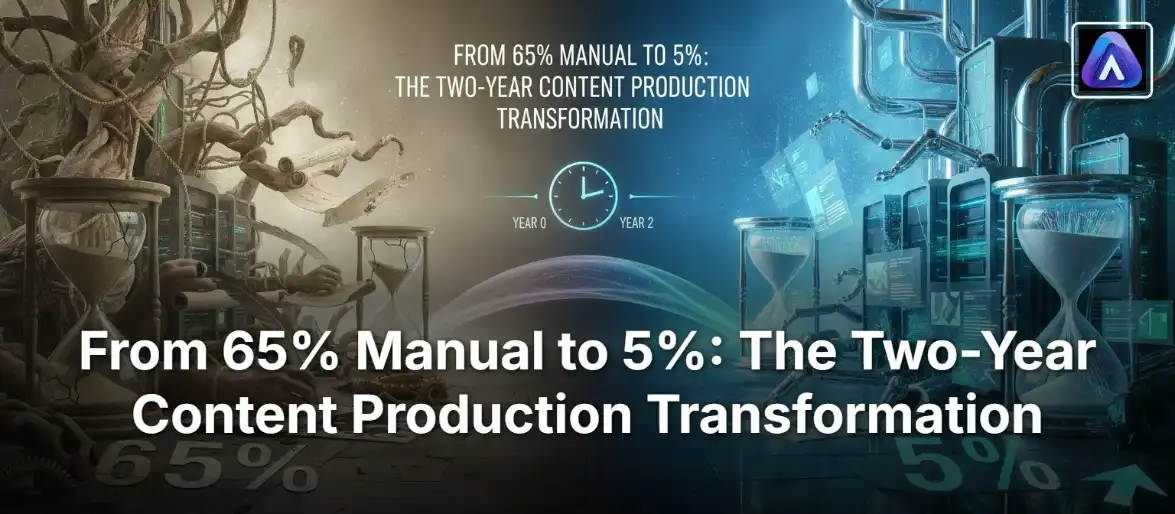
The landscape of digital publishing has undergone a radical shift since early 2023. Two years ago, most marketing departments operated on a manual-first basis where humans drafted every sentence. Today, the industry has moved from 65% manual to 5%: The Two-Year Content Production Transformation that redefined how we communicate at scale. This change represents more than just a speed increase; it is a fundamental restructuring of creative operations.
The Evolution of Content Production Since 2023
In early 2023, the adoption of generative tools was largely experimental. Most teams used large language models for brainstorming or creating basic outlines. The primary work of drafting, fact-checking, and formatting remained a heavy manual burden. As the content production evolution since 2023 progressed, these tools moved from the periphery to the core of the workflow.
By 2024, the industry witnessed the rise of specialized workflows that integrated multiple AI agents. These agents took over specific tasks such as search engine optimization (SEO) analysis and initial draft generation. This reduced the time spent on repetitive tasks by over 50 percent for many enterprises. The focus shifted from writing words to managing the systems that generate them.
Decline in Manual Content Creation (2023-2026)
Mapping the Decline in Manual Content Creation
The decline in manual content creation reflects a broader trend toward operational efficiency. In the past, a single blog post might require six hours of manual labour. Today, that same post is often generated, checked, and published in under thirty minutes. Humans now act as editors-in-chief rather than primary writers. This shift allows teams to produce vast amounts of high-quality material without increasing their headcount.
Reduced Lead Times
Consistent Brand Voice
Data-Driven Quality
Workflow Comparison: 2023 vs 2026
Production Methodology Shift
A direct comparison of how content operations have matured over the last 24 months.
| Feature | Manual-First (2023)Relies on human drafting and manual research cycles. | RecommendedAgentic AI (2026)Uses autonomous agents for research, drafting, and distribution. |
|---|---|---|
| Research Speed | 2-4 Hours | 30 Seconds |
| Drafting Method | Manual typing | LLM Generation |
| SEO Optimisation | Post-draft check | Built-in at source |
| Scalability | Linear/Limited | Exponential |
| Human Role | Creator | Strategist/Editor |
The Remaining 5%: Why Human Oversight Matters
While 95% of the production process is now automated, the final 5% is more critical than ever. This small percentage represents the strategic layer where humans provide unique insight. Strategy, final approval, and proprietary data integration cannot be fully outsourced to machines. Humans ensure that the content aligns with long-term business goals and maintains emotional resonance with the audience.
The transition from 65% manual to 5% is not about replacing people, but about elevating their roles from labourers to architects of information.
Organisations that ignore this 5% often struggle with brand dilution. Automated systems are excellent at following patterns but they cannot invent new brand philosophies. The modern content professional focuses on training models and refining prompts rather than checking grammar. This high-level supervision prevents the 'sea of sameness' that can occur with unedited AI output.
| Task Category | 2023 Manual Time | 2026 AI-Assisted Time | Efficiency Gain |
|---|---|---|---|
| Keyword Research | 60 mins | 2 mins | 96.6% |
| First Draft (1k words) | 180 mins | 1 min | 99.4% |
| Fact Checking | 45 mins | 5 mins | 88.8% |
| Visual Selection | 30 mins | 2 mins | 93.3% |
Impact on Content Quality and Search Performance
A common concern during this transformation was the potential drop in quality. However, data from 2025 and 2026 suggests that quality has actually stabilised or improved. Automated systems can cross-reference thousands of data points in seconds. This leads to more accurate technical content and better-optimised metadata. Search engines have also adapted, focusing on the utility of the content rather than its origin.
Proportion of marketers who have integrated AI into their primary content creation strategy as of 2026.
View source →To remain competitive, businesses must now produce content at a volume that was previously impossible. The market has moved from individual articles to massive content clusters. These clusters cover every possible user query within a specific niche. Without the shift from 65% manual to 5%: The Two-Year Content Production Transformation, keeping up with these new volume standards would be financially unfeasible.
Frequently Asked Questions
Summary of Key Findings
The journey from 2023 to 2026 has been the fastest technological adoption in marketing history. We have moved from a world of manual drafting to a world of strategic oversight. This transformation allows for unprecedented scale while maintaining strict quality controls. As we look forward, the focus will remain on how humans can best direct these powerful automated systems.