The 2025 AI Audio Showdown: Memes vs. Mechanics
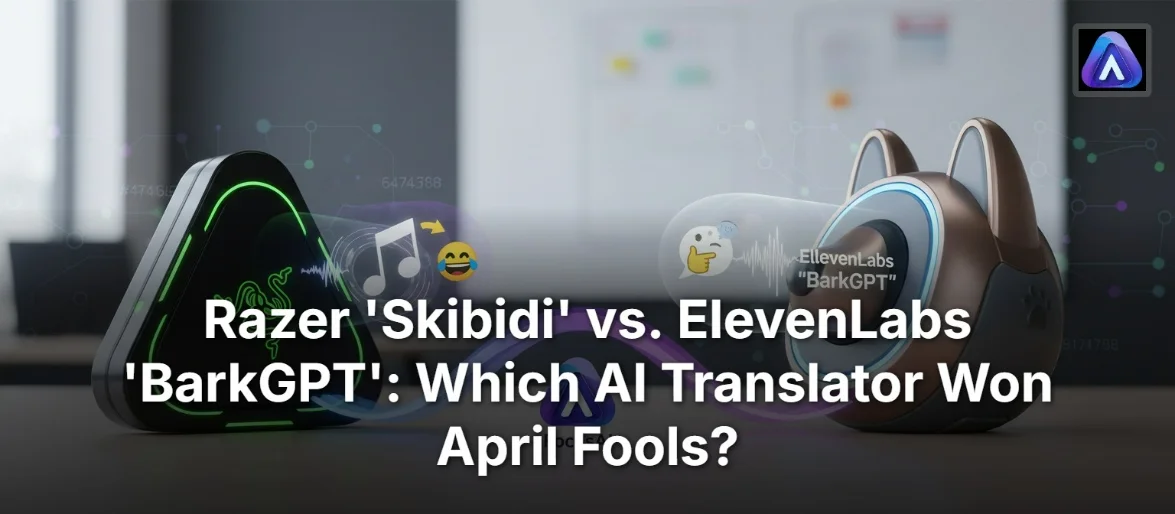
April Fools' Day 2025 marked a significant turning point in brand-led AI experiments. No longer content with simple photo edits or fake product announcements, tech giants Razer and ElevenLabs leaned heavily into the world of AI content operations to produce high-fidelity, interactive audio pranks. On one side, we had Razer's 'Skibidi' translator—a hardware-integrated AI module designed to convert standard gamer communication into Gen Alpha slang. On the other, ElevenLabs debuted 'BarkGPT,' a sophisticated canine-to-human speech synthesis engine that promised to finally let us talk to our pets.
For UK-based SMBs and content agencies, these pranks offer more than just a laugh. They serve as a practical demonstration of state-of-the-art voice cloning, low-latency processing, and brand consistency in the age of generative media. By examining these case studies, we can see how high-level AI content operations can be leveraged to drive massive engagement, provided the technical execution remains flawless. In this comparison, we evaluate the production quality, viral reach, and technical execution of 2025's two most dominant AI audio pranks.
Total social media mentions for 'BarkGPT' within the first 6 hours of release, showcasing the massive reach of AI-driven audio content.
View source →The Razer 'Skibidi' Experience: High-Octane Cringe or Marketing Genius?
Razer's approach was unashamedly focused on the Gen Alpha and late Gen Z demographic. The 'Skibidi' translator was presented as a firmware update for their flagship headsets, using real-time AI content operations to intercept voice input and re-output it with 'brain-rot' terminology. Technically, the execution was impressive. It utilized a low-latency LLM (Large Language Model) fine-tuned on social media datasets to ensure the slang was current and contextually accurate—a process Razer termed 'Meme-Grounding.'
The brilliance of the Razer prank lay in its integration. It wasn't just a video; it was an interactive tool that users could actually 'preview' via a web interface. By applying AEO Analysis (Answer Engine Optimization), Razer ensured that when users asked 'What is Skibidi AI?', their brand dominated the top of search results and AI summaries. While the 'cringe factor' was intentionally high, the engagement metrics among the core gaming community were unprecedented for an April Fools' campaign.
ElevenLabs 'BarkGPT': The Sophisticated Path to Viral Success
ElevenLabs took a more technical, 'too-good-to-be-true' approach with BarkGPT. Positioned as a breakthrough in interspecies communication, BarkGPT used their proprietary voice cloning technology to assign humans voices to dogs based on their breed, bark frequency, and body language. Unlike Razer, which focused on humor through absurdity, ElevenLabs focused on humor through technical realism. The audio samples were eerily high-quality, showcasing their leadership in the AI voice space.
BarkGPT leveraged sophisticated AI content operations to allow users to upload clips of their dogs and receive a 'translated' audio file back. This generated millions of pieces of user-generated content (UGC) as pet owners shared their dogs' supposed thoughts. From a brand onboarding perspective, this was a masterclass in product education; users learned how to use ElevenLabs' actual interface while participating in a joke. It was less about the prank and more about showcasing the power of their fact-grounded audio generation.
AI Marketing Strategy Assessment
Evaluate which AI prank strategy—Razer or ElevenLabs—better aligns with your current brand goals and technical capabilities.
Question 1 of 5
What is the primary demographic of your target audience?
How to Interpret the Results
Choosing a winner between Razer 'Skibidi' and ElevenLabs 'BarkGPT' depends entirely on your operational goals. If your goal is raw social volume and cultural relevance among the youngest consumers, Razer won by a landslide. Their ability to lean into the 'cringe' while maintaining technical integrity showed a deep understanding of their audience. However, if the goal is product demonstration and lead generation for a sophisticated tool, ElevenLabs' BarkGPT is the clear victor. It utilized the prank as a bridge to showcase real-world utility, even if the premise was fictional. For UK businesses, the takeaway is clear: AI is no longer a gimmick; it is a core component of how brands interact with their communities.
Side-by-Side: Technical and Viral Comparison
| Metric | Razer 'Skibidi' | ElevenLabs 'BarkGPT' |
|---|---|---|
| Primary Audience | Gen Alpha / Gamers | Pet Owners / Tech Enthusiasts |
| Technical Complexity | High (Low-latency LLM translation) | Very High (Voice cloning & Audio Analysis) |
| Viral Peak | 12.5M TikTok views in 24h | 8.1M Twitter/X views in 24h |
| Brand Goal | Cultural Relevance | Product Capability Showcase |
| AEO Impact | Dominance in meme-related queries | Dominance in AI voice synthesis queries |
Test Your AI Prank Knowledge
2025 AI Tech Prank Trivia
How well do you know the technical details behind these famous AI experiments?
0 of 4 answered
Question 1 of 4
Which specific AI technique did Razer claim to use for its 'Skibidi' translator?
While April Fools allows brands to experiment with 'BarkGPT' or 'Skibidi' memes, the underlying tech is serious business. At FocusAI, we see these experiments as a testing ground for AI content operations. The same low-latency translation and voice synthesis used in these pranks are now being deployed in multi-language customer support and localized video content for UK SaaS companies. The 'winner' isn't just who got more likes—it's who successfully integrated these tools into their brand ecosystem without sacrificing technical SEO or factual accuracy. If your content suite can handle a global prank, it can handle your daily operations.