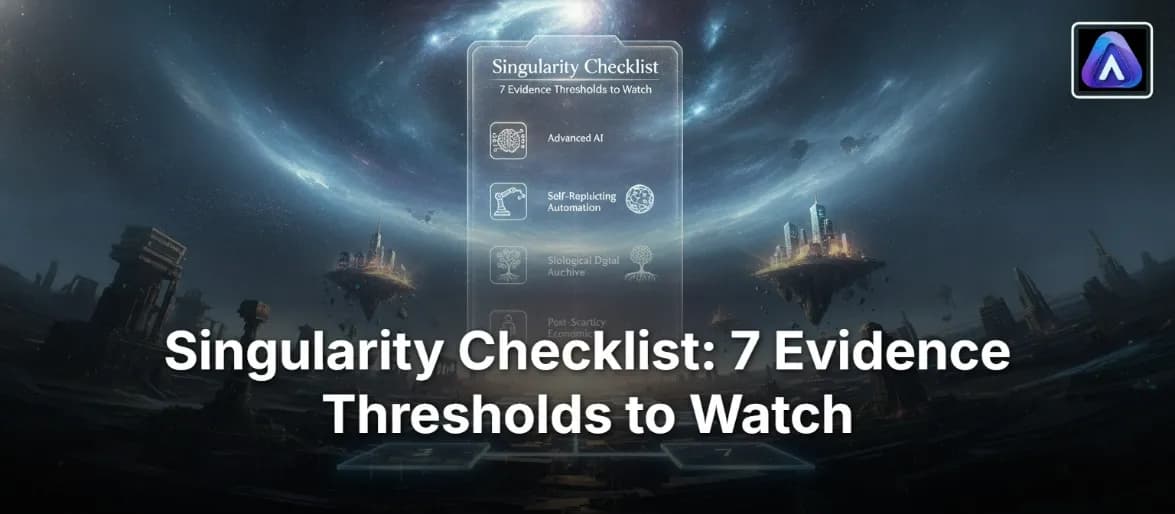
Understanding the Singularity Debate
Discussions surrounding artificial intelligence frequently touch upon the technological singularity. This concept describes a hypothetical future point where machine intelligence exceeds human capability. Mathematician Vernor Vinge first formalized this framework in 1993. He argued that recursive self improvement would drive runaway technological acceleration.
Recent executive statements claim that humanity has already entered this phase. Industry observers counter that current commercial models lack the fundamental mechanics required for true autonomy. Evaluating this debate demands structured frameworks rather than marketing rhetoric. Analysts must track measurable technical indicators instead of relying on subjective impressions.
The year mathematician Vernor Vinge formally defined the technological singularity as machine self improvement.
The Seven Evidence Thresholds for Recursive Self-Improvement
Recursive self improvement requires specific architectural milestones. Systems must autonomously diagnose their own source code limitations. They must rewrite their core algorithms without human intervention. Monitoring these thresholds prevents confusion between incremental scaling and genuine qualitative transformation.
Singularity Monitoring Framework
Seven operational thresholds required to validate true recursive self improvement in artificial intelligence systems.
Autonomous Code Modification
Cognitive Independence
Exponential Acceleration
Systemic Resilience
Comparative Metrics of Current Systems
Current commercial models demonstrate remarkable pattern recognition. However, they rely heavily on human curated training data and static deployment pipelines. Examining concrete operational metrics clarifies the gap between current software capabilities and theoretical singularity requirements.
| Evaluation Vector | Current LLM Status | Singularity Threshold Requirement |
|---|---|---|
| Code Modification | Assists human programmers via completion | Autonomous architectural redesign |
| Resource Management | Operates within human defined cloud limits | Independent physical and financial scaling |
| Knowledge Generation | Interpolates existing human text corpora | Generates unprompted foundational science |
| Cycle Velocity | Requires human managed release windows | Continuous recursive upgrade loops |
Progress Toward Autonomous Benchmarks
The singularity has two features. The AI systems commercialized today do not deliver on either of them.
Evaluating Operational Risks and Reality
Organizations must separate short term automation gains from long term existential projections. Conflating sophisticated statistical models with runaway superintelligence creates poor risk management strategies. Technical leaders should focus on verifiable boundaries rather than speculative timelines.
Deployment Cycles
Alignment Boundaries