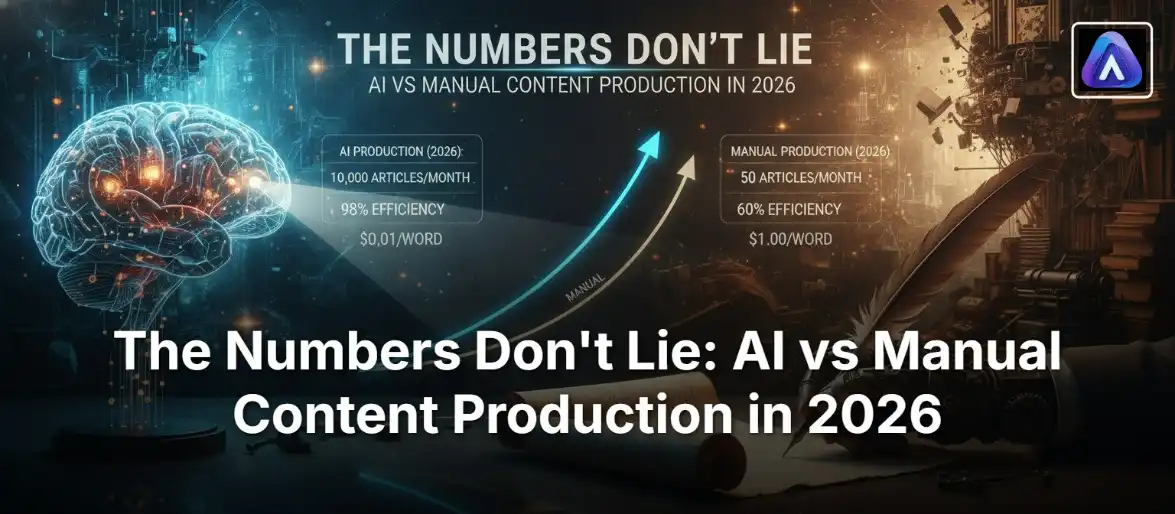
The landscape of digital publishing has undergone a seismic shift since 2023. At that time, many organisations viewed generative technology as an experimental tool rather than a core component of their operations. By 2026, the data indicates that the experimental phase has concluded. The adoption of artificial intelligence for content generation has transitioned from a competitive advantage to a fundamental industry standard for most marketing teams.
The Collapse of Purely Manual Workflows
In 2023, approximately 65% of blog content was produced using purely manual workflows. Writers conducted research, drafted outlines, and wrote every sentence without the assistance of generative models. Recent data from early 2026 shows this figure has plummeted to just 5%. This decline represents a fundamental change in how businesses perceive the value of human labor in the initial stages of the content lifecycle.
Efficiency gains are the primary driver of this transition. A manual blog post that previously required six hours of production can now be conceptualised and drafted in under thirty minutes using modern tools. This efficiency has allowed teams to increase their output volume while reallocating human hours to higher level strategy. Strategic planning and original research are now the primary domains where human expertise is focused.
The Rise of the Hybrid Content Model
While manual production is fading, pure AI production is also seeing a nuanced correction. In 2023, many firms attempted to use 100% automated systems to generate high volumes of low quality text. Data from 2024 and 2025 indicated a decline in this approach, falling from 44% to roughly 35%. This shift suggests that the industry has recognised the limitations of unedited machine output.
The dominant model in 2026 is the hybrid approach. In this system, AI handles the data processing, initial drafting, and structural formatting, while human editors provide fact checking and brand voice alignment. Approximately 80% of creators now use AI in at least part of their workflow. This ensures that the speed of the machine is balanced by the accuracy and emotional resonance of a human professional.
The debate is no longer about whether to use AI, but how to integrate it without losing the unique perspective that drives reader engagement. The numbers show that those who use AI as a collaborator rather than a replacement are seeing the highest returns on investment.
Comparing Production Metrics: Manual vs. AI-Driven
To understand why the market has shifted so rapidly, we must examine the cost and time metrics. Manual production remains the most expensive and slowest method available to modern marketing departments. For companies operating at scale, the price difference between these two methods is often the difference between profit and loss.
| Metric | Manual (2026) | AI-Hybrid (2026) | Pure AI (2026) |
|---|---|---|---|
| Production Time (Per Item) | 4.5 Hours | 45 Minutes | 2 Minutes |
| Average Cost (GBP) | £250 - £400 | £45 - £90 | £5 - £15 |
| Quality Score (1-10) | 8.5 | 9.0 | 6.5 |
| Fact-Checking Requirement | Medium | High | Critical |
Production Volume Growth by Strategy (2023-2026)
Strategic Implementation of Production Models
The choice between these production methods depends largely on the intended use of the content. Technical documentation and deep investigative journalism still benefit from a heavier manual presence. Conversely, social media updates and standard SEO articles are now almost exclusively the domain of hybrid systems.
Content Strategy Comparison 2026
A comparison of the three primary content production frameworks used by UK businesses.
| Feature | Manual TraditionalHuman-only research and writing for high-stakes thought leadership. | RecommendedAI-HybridMachine generation with comprehensive human editorial oversight. | Fully AutomatedEnd-to-end machine generation for high-volume data-driven updates. |
|---|---|---|---|
| Production Speed | Low | High | Instant |
| Cost Efficiency | Low | High | Maximum |
| Accuracy | High | High | Variable |
| SEO Performance | Good | Excellent | Average |
| Typical Use Case | Books/Op-Eds | Blogs/Websites | Data Reports |
Operational Nuances in the 2026 Workflow
Organisations are now investing more in prompt engineering and data grounding than in traditional copywriting training. Data grounding refers to the process of connecting a generative model to a specific, verified dataset to prevent errors. This ensures that the output is not just grammatically correct but factually accurate according to the latest market information.
Fact Verification
Brand Voice Alignment
Rapid Iteration
Frequently Asked Questions
The Path Forward for Content Teams
The transition from manual to machine-assisted production is permanent. Businesses that continue to rely solely on manual processes face significant challenges in cost and scalability. By adopting a hybrid model, teams can maintain the quality of their brand while benefiting from the unprecedented speed of 2026 technology.