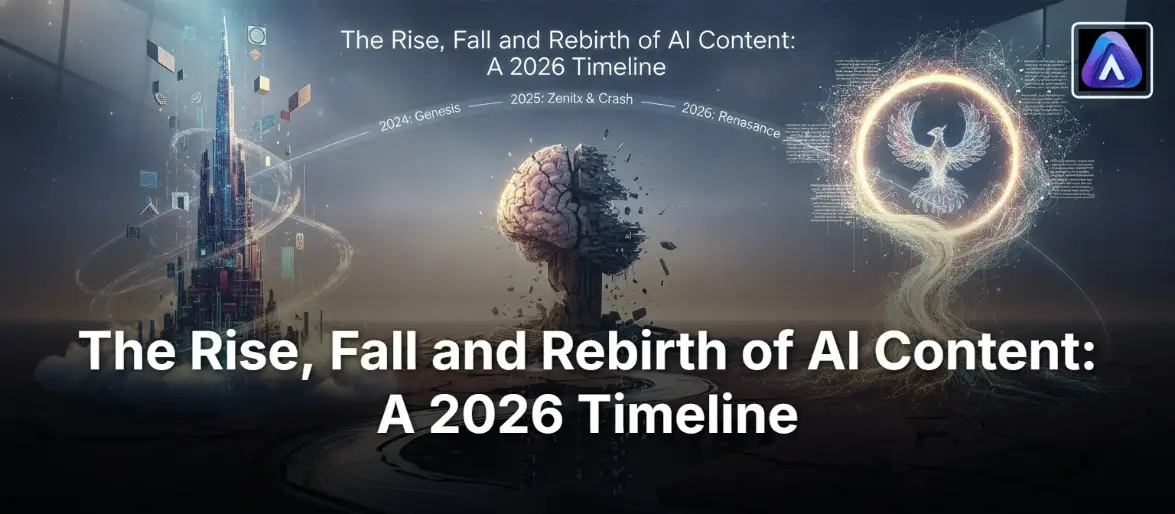
The digital landscape has undergone a radical transformation since the public release of large language models. In less than four years, the internet transitioned from a human-centric space to one saturated by automated production. This journey began with widespread amazement before descending into a period of low-quality saturation known as the slop era. By 2026, the industry has reached a turning point where quality and verification once again dictate search visibility.
Executive Summary: The Three Ages of AI Content
The evolution of generative text is best understood through three distinct phases. Each phase represents a shift in how businesses approached automation and how search engines responded to the changing volume of data. Understanding this history is essential for any digital strategist looking to navigate the current demand for high-authority, grounded information.
2022 to 2023: The Age of Infinite Creation
The launch of ChatGPT in late 2022 marked the beginning of a rapid adoption cycle. During this period, the primary focus was on the sheer scale of production. Marketers and business owners realised they could produce thousands of articles for a fraction of the previous cost. This led to a gold rush where quantity often outweighed structural integrity or factual accuracy.
Initial reactions from search engines were cautious. Early adopters found that they could rank easily for long-tail keywords by flooding the index with AI-generated text. However, this success was temporary as the lack of original insight began to degrade the user experience across the web.
Early hallucinations were a major hurdle, but the real challenge was the shift away from quality toward volume-driven output that lacked human oversight.
2024 to 2025: The Fall and the Rise of AI Slop
By 2024, the term AI slop entered the public consciousness. It describes low-quality, high-volume generative content that offers little value to the reader. These articles were often produced without human editing and were designed solely to capture search traffic rather than to inform or educate. This trend became so prevalent that Merriam-Webster named slop its Word of the Year for 2025.
The consequence of this saturation was a massive loss of trust. Platforms like Reddit and niche forums saw a surge in traffic as users looked for human-vetted answers. Search engines responded with aggressive core updates that targeted unhelpful, automated content. Many websites that relied on unedited AI text saw their visibility drop by more than 80 percent during this period.
| Period | Content Characteristic | Market Sentiment |
|---|---|---|
| 2022-2023 | Experimental and Novel | Amazement and Rapid Adoption |
| 2024-2025 | High Volume (Slop) | Backlash and Distrust |
| 2026 | Verified and Grounded | Premium on Human Authority |
The 2026 Rebirth: Grounded Content and Authority
We are now in the era of the rebirth. In 2026, the industry has moved beyond simple generation. Modern content strategies now prioritise Retrieval-Augmented Generation (RAG). This technology ensures that AI outputs are grounded in specific, verifiable datasets rather than general training data. This shift has restored trust by providing citations for every major claim.
Modern content must meet a higher threshold of evidence. Search engines now prioritise articles that include unique data, expert interviews, and proprietary research. The role of the human editor has transitioned from a proofreader to a subject matter expert who ensures the AI maintains brand consistency and factual precision.
User Trust in AI-Generated Content (2023-2026)
Key Characteristics of 2026 Quality Standards
Verifiable Citations
First-Person Experience
Real-time Grounding
Common Questions on Content Evolution
Conclusion and Next Steps
The timeline of AI content shows a clear arc from quantity back to quality. For UK businesses, the priority has shifted toward building long-term authority. To succeed in the current environment, focus on developing a content library that relies on original data and rigorous verification. The slop era has ended, and the era of the trusted expert has returned.