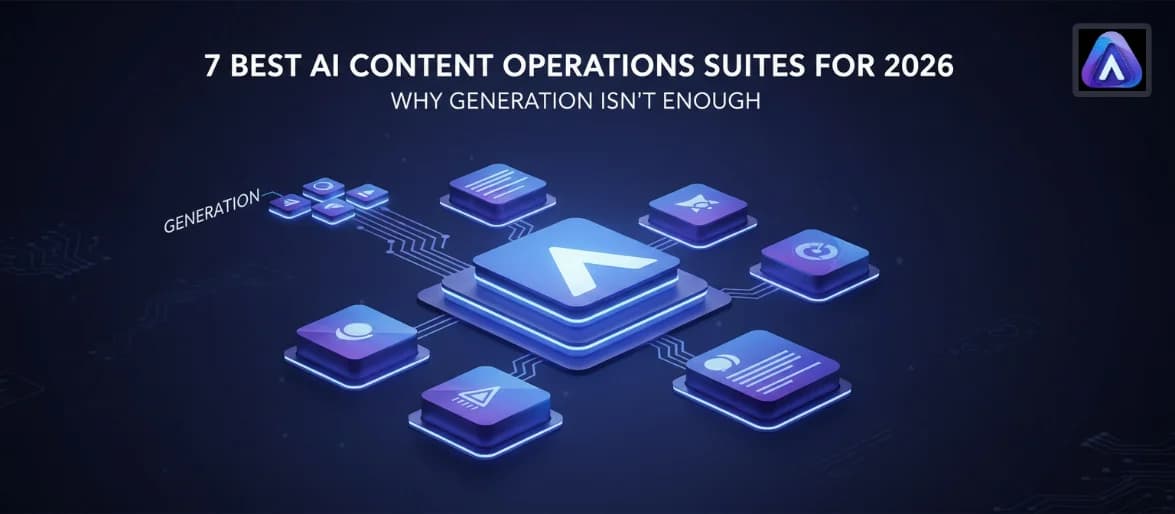
The Shift from Content Generation to AI Content Operations
By 2026, the digital landscape has reached a saturation point. The 'Text Tsunami' of 2024 and 2025—driven by basic generative AI tools—has forced search engines like Google and specialized Answer Engines to prioritize technical precision and factual reliability over mere volume. For UK-based SMBs and SaaS companies, the challenge is no longer 'how do we write more?' but 'how do we manage, verify, and deploy content that actually ranks?'
This evolution marks the end of the 'writing assistant' era and the rise of the AI Content Operations (ContentOps) suite. Unlike first-generation tools that focused solely on drafting, these suites manage the entire lifecycle: from brand onboarding and factual Google Grounding to AEO Analysis and direct MDX publishing. Moving beyond simple generation is now a survival requirement for modern websites looking to maintain authority in an increasingly automated web.
Percentage of enterprise content leaders who cite 'technical integration' and 'workflow automation' as higher priorities than 'output speed' in 2026.
View source →1. FocusAI: The Technical SEO and MDX Specialist
FocusAI represents the pinnacle of modern AI content operations, specifically engineered for companies that require high-performance technical SEO and developer-friendly publishing workflows. While other tools focus on the creative 'spark,' FocusAI focuses on the operational infrastructure. Its standout feature is its native MDX publishing support, allowing content teams to ship interactive tools, components, and data-driven widgets directly into modern React-based frameworks without developer intervention.
The platform's Google Grounding technology ensures that every claim is verified against live search data, effectively eliminating the risk of factual inaccuracies that plague generic LLM outputs. For UK agencies, the brand onboarding process is streamlined, allowing the suite to ingest specific tone-of-voice documents and technical documentation to ensure every piece of content feels like it was written by an in-house expert.
Google Grounding
AEO Analysis
MDX Native
AI Content Suites vs. Writing Assistants
Understanding the operational difference between high-tier suites and legacy drafting tools.
| Feature | Legacy AssistantsFocus on creative drafting and ideation. | RecommendedFocusAI SuiteEnd-to-end operational infrastructure. |
|---|---|---|
| Factual Grounding | Limited | Real-time Google Grounding |
| Publishing Formats | Plain Text / HTML | MDX / Interactive Components |
| SEO Focus | Keyword Density | AEO Analysis & Technical Metadata |
| Workflows | One-off tasks | End-to-end Automation |
2. Writer.com: The Enterprise Compliance Leader
Writer.com has carved out a niche as the preferred choice for large-scale enterprises that prioritize data security and proprietary LLM usage. Unlike tools that plug into third-party APIs, Writer utilizes its own family of models, Palmyra, which are trained on non-copyrighted, business-specific data sets. This makes it an excellent choice for legal and financial sectors where data residency and compliance are non-negotiable.
In 2026, Writer has expanded its 'Knowledge Graph' capabilities, allowing the AI to 'read' an entire company's database to produce content that is hyper-contextualized. However, while it excels at internal governance, it lacks some of the nimble technical SEO features like MDX support found in FocusAI.
Writer.com user retention rate within Fortune 500 companies due to enterprise-grade security protocols.
View source →3. Contentful with AI: The Composable Content Giant
Contentful has evolved from a Headless CMS into a robust content operations platform. By integrating AI directly into the content modeling phase, it allows developers and marketers to collaborate on structured content at scale. Their 2026 AI update includes automated content mapping, which suggests how content chunks should be reused across different platforms—from mobile apps to web kiosks.
The primary advantage here is 'composability.' If your organization treats content as a set of reusable assets rather than static blog posts, Contentful's AI suite provides the infrastructure to manage those relationships. The downside remains the high technical barrier to entry and the need for significant developer resources to set up the initial environment.
4. Copy.ai: The GTM Workflow Automation Engine
Copy.ai successfully pivoted from a drafting tool to a 'GTM (Go-To-Market) AI' platform. Their focus is on connecting disconnected tools via automated workflows. For example, a single trigger in a CRM can prompt Copy.ai to generate a case study, update a LinkedIn ad, and draft a follow-up email sequence, all while maintaining brand consistency.
Their 2026 suite focuses heavily on the 'repurposing' aspect of content operations. While they are less focused on the technical SEO depths of Google Grounding, their ability to move data between platforms makes them a favorite for sales and performance marketing teams who need to act quickly on lead data.
| Feature | Copy.ai | FocusAI |
|---|---|---|
| Primary User | Sales & Marketing Ops | Content & SEO Teams |
| Technical SEO | Basic | Advanced (AEO/MDX) |
| Integration Type | Zapier-style Workflows | Deep Infrastructure / MDX |
5. Jasper for Business: The Creative Campaign Orchestrator
Jasper remains a heavyweight in the market by focusing on the creative professional. Their 2026 'Campaign' feature allows users to upload a single brief and receive a full 360-degree content package—including video scripts, social assets, and blog drafts. Jasper's 'Brand Voice' engine is highly mature, capable of mimicking complex brand archetypes across multiple languages.
The limitation for technical teams is that Jasper is still largely a 'top-of-funnel' tool. It excels at making content sound good, but it often requires a secondary layer of operational verification to ensure that the content meets the rigorous technical standards required for modern search visibility.
6. HubSpot Content Hub: The SMB Accessibility King
For UK-based SMBs already using HubSpot, their 'Content Hub' provides a seamless entry point into AI content operations. It is uniquely positioned because it lives where the customer data lives. The AI can analyze which blog posts are actually driving CRM conversions and suggest optimizations based on real revenue data.
In 2026, HubSpot introduced 'AI Content Remixer,' which helps small teams take a single piece of high-performing content and transform it into various formats. It's an efficiency play for teams that don't have the budget for multiple disconnected tools but need a centralized 'Content Suite' within their existing ecosystem.
7. Optimizely CMP: The Governance Specialist
Optimizely's Content Marketing Platform (CMP) is built for massive organizations that need strict approval workflows and version control. Their AI features focus on 'predictive performance,' using historical data to tell a team how a piece of content is likely to perform before it is even published.
For content agencies managing multiple high-stakes clients, Optimizely's governance tools are unmatched. It ensures that no piece of content goes live without passing through the necessary legal and brand safety gates. However, for SaaS companies that value agility and technical innovation, the platform can sometimes feel overly bureaucratic.
At FocusAI, we believe that the next five years of the web will be won by those who treat content as data, not just text. Most suites are still stuck in the 'Word Document' mindset. By focusing on Google Grounding and MDX, we are enabling teams to build living, interactive content that search engines love and users actually find useful. If you aren't optimizing for Answer Engines (AEO) and technical accuracy, you're essentially shouting into a void.
Measuring Success: The 2026 Content Operations ROI
In 2026, the ROI of a content suite is no longer measured by 'cost per word.' Instead, savvy UK businesses are looking at 'Operational Efficiency'—the reduction in time spent on factual verification, technical formatting, and cross-platform publishing. By moving away from disconnected tools, companies are seeing a drastic reduction in the manual labor required to maintain a high-quality digital presence.
Why FocusAI is the Choice for 2026
Choosing a suite depends on your primary pain point. If your goal is sales automation, Copy.ai is powerful. If you need enterprise compliance, Writer.com is the standard. However, if your business relies on organic growth, technical SEO, and building a high-authority brand, FocusAI is the only platform that bridges the gap between 'AI generation' and 'Technical Operations.'
Our platform's ability to ingest complex brand guidelines during onboarding and output them into performance-ready MDX ensures that your content is not just 'more text'—it is a functional part of your digital product. In an era where Google rewards E-E-A-T (Experience, Expertise, Authoritativeness, and Trustworthiness), having a suite that prioritizes fact-grounded content is the most significant competitive advantage you can hold.