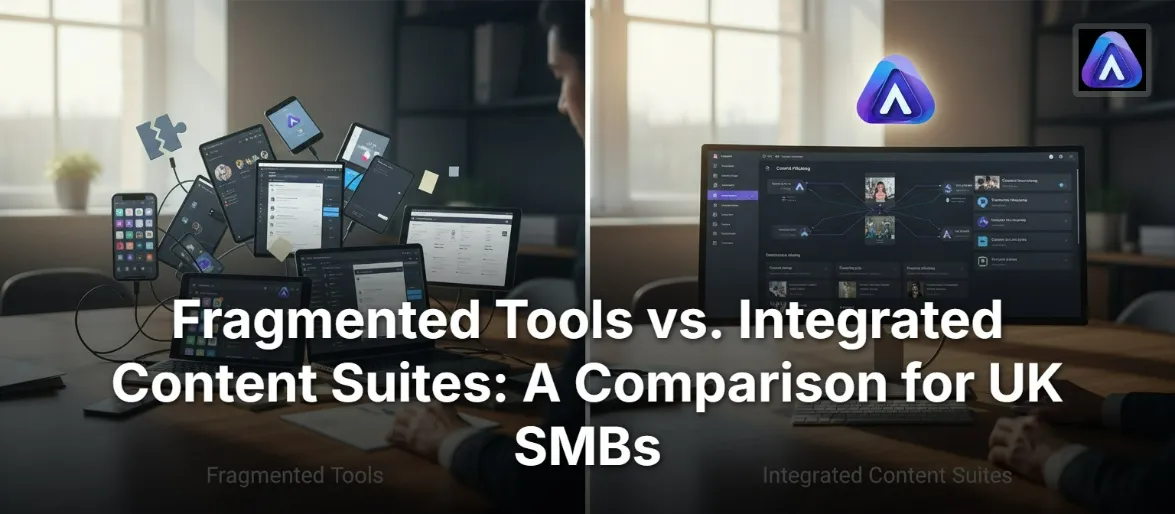
The operational landscape for UK SMBs has shifted from a shortage of tools to an overwhelming surplus. Many marketing departments now manage a patchwork of applications for keyword research, drafting, fact-checking, and SEO optimisation. While individual tools offer specific benefits, these disconnected systems create significant technical debt. This analysis compares the financial and operational reality of fragmented workflows versus an integrated AI content operations suite.
The True Cost of Disconnected Tools
Many UK businesses begin their AI journey with one subscription to a popular LLM. Over time, they add more for SEO analysis, plagiarism detection, image generation, and brand voice. By the time content is ready for publishing, a team member has often copied and pasted text across five different interfaces.
The primary issue is not just the subscription cost, but the 'transfer tax', the time lost to manual formatting and prompt engineering. When tools are not integrated, brand consistency suffers. If a generation tool is unaware of specific AEO Analysis from a keyword tool, the content often misses the mark. This necessitates manual editing, which defeats the purpose of using AI for efficiency.
| Resource Type | Fragmented Toolset (Est. Monthly) | Integrated Content Suite (Est. Monthly) |
|---|---|---|
| Software Licensing | £350 - £600 | £150 - £300 |
| Human Review Time | 25 Hours | 6 Hours |
| API & Credit Overages | Variable (High) | Included |
| Technical Maintenance | 4 Hours | 0 Hours |
Technical Overhead and the Risk of Data Silos
Fragmented systems create data silos where brand guidelines and factual databases remain isolated. Ensuring accuracy then requires manual cross-referencing against primary sources. This is where many UK SMBs face 'hallucination' risks, which we view as a failure of data grounding. Without integrated Google Grounding, the AI lacks a real-time connection to facts, making it unsuitable for technical or legal content.
Publishing from disconnected tools is often a manual process involving Word or Google Docs. Integrated suites use MDX publishing to move content directly from generation into a code-ready format. This format respects technical SEO standards, such as schema markup and internal linking, removing the final bottleneck in the pipeline.
Production Time Distribution: Fragmented vs. Integrated
The Benefits of Integrated AI Content Operations
An integrated suite acts as a single source of truth for your content strategy. Once a brand is onboarded, the AI understands your specific tone, audience, and terminology from the first prompt. This systemic approach ensures every piece of content is pre-optimised for AEO Analysis, maintaining visibility in next-generation search engines.
- Unified Brand Onboarding: Define your voice once and apply it across all outputs.
- Google Grounding: Real-time fact-checking against search engine data to ensure accuracy.
- Automated MDX Publishing: Seamless export to modern web frameworks without manual formatting.
- AEO Analysis: Content built specifically for Answer Engine Optimisation and AI search summaries.
- Centralised Analytics: Track the ROI of your entire content suite from one dashboard.
Fragmented Tools vs. Integrated Suites
A detailed look at the operational differences between a 'best of breed' disconnected stack and a unified content operations platform.
| Feature | Fragmented StackMultiple subscriptions (e.g., ChatGPT, Jasper, SurferSEO, Grammarly) | RecommendedFocusAI Content SuiteUnified platform for research, generation, grounding, and publishing |
|---|---|---|
| Workflow Style | Copy-Paste Heavy | End-to-End Automated |
| Fact Checking | Manual/Separate | Automated Google Grounding |
| Brand Consistency | Per-Prompt Manual Input | Native Brand Onboarding |
| Technical SEO | Manual Plugin Checks | Native MDX Publishing |
| Total Monthly Cost | £400+ | From £199 |
The Impact on Content Marketing ROI
ROI is often miscalculated by focusing only on the cost per word. For a UK SMB, the real metric is the total cost of ownership (TCO) relative to organic traffic and leads. Disconnected tools keep TCO high by requiring human intervention at every stage. An integrated suite lowers TCO by automating manual tasks, allowing your team to focus on high-level strategy and expert insights.
In our experience with UK-based agencies, the shift to an integrated suite often reveals that 'tool fatigue' was the primary reason for inconsistent publishing schedules. By removing the friction of switching between tabs, production consistency typically increases by 3x within the first month of implementation.
Verdict: Why Consolidation is the Strategy for 2024
The era of the 'AI tool for everything' is coming to an end. For UK SMBs looking to remain competitive, the goal is not to have the most tools, but to have the most efficient operation. Integrated content suites provide the necessary infrastructure to scale production without scaling headcount or complexity. By centralising your brand onboarding, fact-grounding, and publishing, you eliminate the fragmentation that leads to brand dilution and technical errors.